- Home
- Advertising and Marketing
- What Is AI Visibility and How to Check AI Visibility: The Complete Guide
What Is AI Visibility and How to Check AI Visibility: The Complete Guide
 By
By The digital landscape is evolving rapidly. For years, brands and content creators obsessed over Google rankings, domain authority, and click-through rates. But a new frontier is emerging — one that is fundamentally changing how people discover information, products, and services online. That frontier is AI visibility.
If you haven’t started thinking about AI visibility yet, you’re already behind. This guide breaks down exactly what AI visibility is, why it matters more than ever, and — most importantly — how to check and improve yours.
What Is AI Visibility?
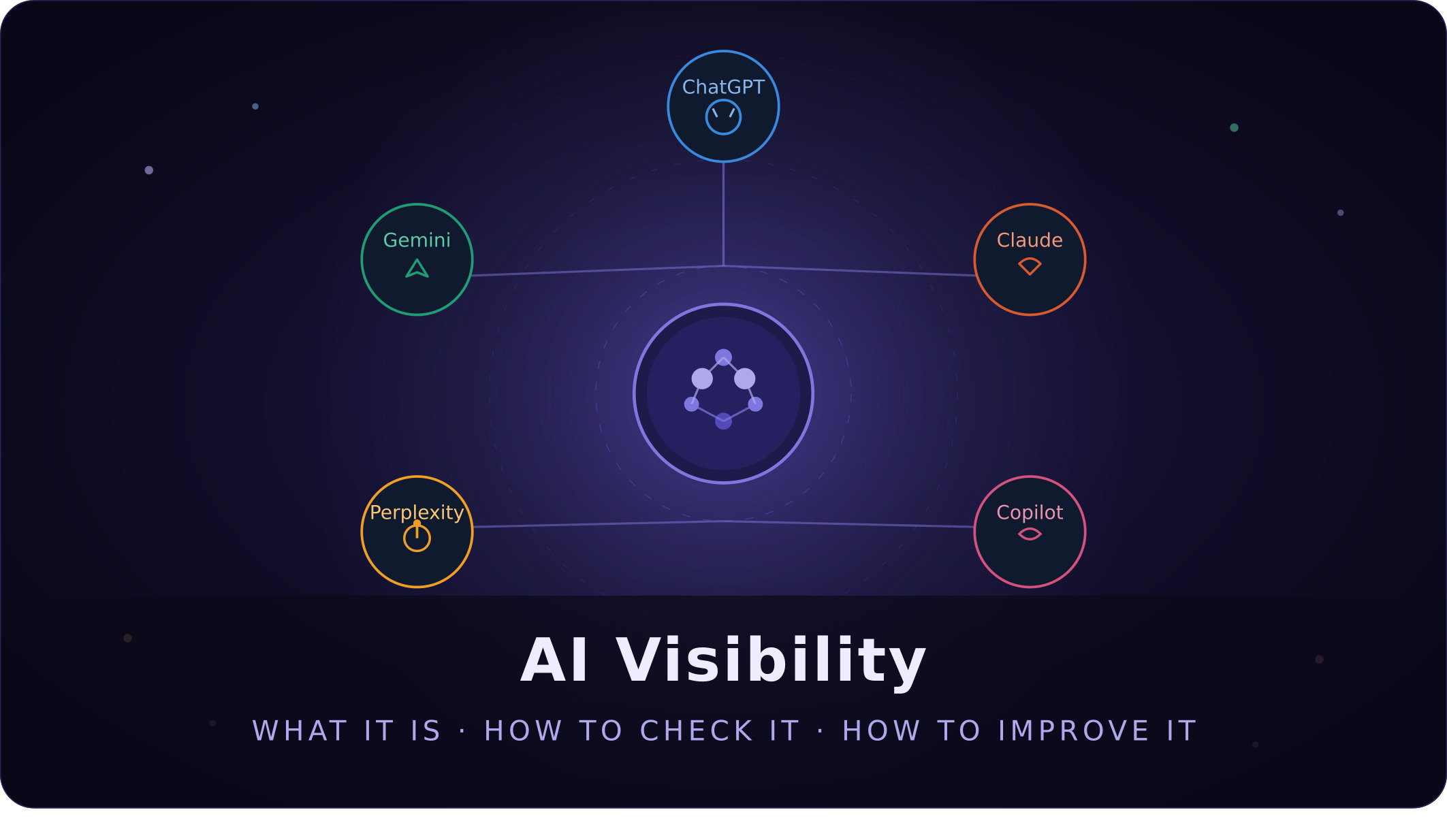
AI visibility refers to how prominently and accurately a brand, product, person, or piece of content appears in the responses generated by artificial intelligence tools. These tools include AI-powered search engines and assistants such as:
- ChatGPT (OpenAI)
- Perplexity AI
- Google Gemini
- Microsoft Copilot
- Claude (Anthropic)
- Meta AI
- You.com
When a user asks an AI assistant “What are the best project management tools?” or “Who is the leading digital marketing agency in India?”, the AI generates a response. AI visibility is about whether your brand appears in that response — and how positively, how accurately, and how prominently it is represented.
In short: AI visibility is your brand’s presence inside AI-generated answers.
This is fundamentally different from traditional SEO. You are not competing for a blue link on a results page. You are competing to be mentioned, recommended, or cited inside a conversational AI response.
Why AI Visibility Matters in 2025 and Beyond
The numbers tell a compelling story. According to multiple industry reports, AI search tools have seen explosive growth, with hundreds of millions of users now turning to AI assistants as their primary source of answers rather than using traditional search engines.
Here’s why this matters for businesses and content creators:
1. Users Trust AI Answers More Than Search Listings
When someone searches on Google, they see 10 blue links and must evaluate each one. When someone asks an AI assistant, they receive a direct, confident answer. Most users accept that answer without further research. If your competitor is mentioned and you are not, you have lost that customer before they even found you.
2. AI Responses Drive Real Purchase Intent
People ask AI assistants questions like:
- “What’s the best CRM for a small business?”
- “Which protein powder should I buy?”
- “Who are the top digital marketing agencies in Noida?”
These are high-intent queries. Being included in an AI’s answer for these questions has direct commercial value.
3. Traditional SEO Is No Longer Enough
Ranking on page one of Google is still important, but it no longer guarantees visibility to every user. Many users bypass Google entirely and go straight to an AI tool. AI visibility and traditional SEO must now work together as a unified strategy.
4. AI Citations Are the New Backlinks
When an AI tool cites your website or mentions your brand in a response, it functions like a super-powered backlink. It builds awareness, authority, and trust simultaneously.
How AI Tools Decide What to Include in Their Responses
To improve your AI visibility, you first need to understand how AI language models generate responses. These models are trained on large datasets of text from across the internet, including web pages, publications, reviews, forums, directories, and more.
When generating a response, AI tools consider:
- Training data: Information absorbed during the model’s training phase. Widely covered brands and well-documented topics have a natural advantage here.
- Retrieval-augmented generation (RAG): Many AI tools like Perplexity and Google Gemini actively search the web in real time and pull in recent content before generating a response.
- Source authority: Content from established, authoritative domains is weighted more heavily.
- Consistency of information: If a brand is described consistently across many sources, the AI is more likely to include it and represent it accurately.
- Structured data and clarity: Well-structured content that clearly states what a product does, who it is for, and why it stands out is easier for AI models to extract and use.
This means that AI visibility is not a mysterious black box. It is driven by many of the same fundamentals as good content marketing — but executed with AI interpretation in mind.
How to Check AI Visibility
Now we arrive at the most practical part of this guide. Here are the most effective methods to measure and audit your current AI visibility.
Method 1: Manual Query Testing
The most direct way to check AI visibility is to manually ask AI tools questions that your target audience would ask — and see whether your brand appears in the answers.
Step-by-step:
- Open ChatGPT, Perplexity, Google Gemini, Claude, and Microsoft Copilot.
- Enter 10–20 queries relevant to your niche. Example: “What are the best email marketing tools for startups?” or “Who are the top SEO agencies in [your city]?”
- Record whether your brand is mentioned, how it is described, and whether a link to your website is included.
- Repeat this process every 2–4 weeks to track changes over time.
Tip: Use a spreadsheet to log your results. Track the AI Visibility tool, the query, whether you were mentioned (yes/no), your position in the response (first, second, mentioned in a list, not mentioned), and the sentiment of the description.
Method 2: Brand Mention Audits Across AI Platforms
Go beyond basic queries and systematically test how each AI tool describes your brand directly.
Enter queries such as:
- “Tell me about [Your Brand Name]”
- “What does [Your Brand] offer?”
- “Is [Your Brand] a good choice for [use case]?”
- “What are the pros and cons of [Your Brand]?”
Analyse the accuracy of each response. Are there outdated details, missing services, or incorrect descriptions? This kind of audit also reveals knowledge gaps — areas where the AI has little to no information about you, which represents an opportunity to create more targeted content.
Method 3: Use AI Visibility Tracking Tools
Several platforms are now emerging specifically to help brands track AI visibility at scale. Tools to explore include:
- Profound – monitors brand mentions across AI search platforms
- Otterly.ai – tracks how your brand appears in AI-generated search results
- Goodie – an AI SEO and visibility monitoring tool
- AirPR / Onclusive – media and brand monitoring platforms expanding into AI coverage
- Semrush AI Toolkit – newer features within Semrush that address AI overview tracking
These tools automate the query-and-record process, allowing you to track hundreds of keywords and queries across multiple AI platforms simultaneously.
Method 4: Track AI Overviews in Google Search
Google now includes “AI Overviews” at the top of many search results pages. These are AI-generated summaries that appear above traditional search listings. You can check your presence in Google AI Overviews by:
- Searching for your target keywords in Google.
- Looking at the AI Overview box at the top.
- Checking whether your content is cited as a source.
- Using Google Search Console to track which pages are being cited in AI Overviews (Google is incrementally releasing this data).
Method 5: Monitor Perplexity Source Citations
Perplexity AI is unique because it explicitly shows which sources it used to generate each answer. This makes it one of the easiest platforms to track your AI visibility on.
Search for your target keywords and niche questions on Perplexity. If your website appears as a cited source in the response, your AI visibility on that platform is strong. If competitors are being cited and you are not, you have a clear gap to address.
How to Improve Your AI Visibility
Once you know where you stand, here is how to improve:
- Publish expert, authoritative content that directly answers the questions your audience asks. Long-form, structured content performs particularly well.
- Build digital PR and brand mentions across reputable publications, industry directories, and review platforms. The more your brand is mentioned consistently across the web, the more familiar AI tools become with it.
- Optimise your structured data using Schema.org markup. This helps AI tools extract accurate, structured information about your brand, products, and services.
- Create FAQ-format content that mirrors the conversational way users ask questions to AI assistants.
- Ensure your brand information is consistent across your website, Google Business Profile, social media, and third-party directories. Inconsistency confuses AI models.
- Get cited on Wikipedia and major reference sources. AI models give significant weight to encyclopaedic, neutral sources.
- Engage in thought leadership through industry publications, podcasts, and interviews. The more your name and brand are associated with expertise in your field, the more likely AI tools are to reference you.
The Future of AI Visibility
AI visibility is not a trend — it is the direction the entire search and discovery ecosystem is heading. As AI tools become smarter, more widely used, and more deeply integrated into how people research and make decisions, your ability to appear in AI-generated responses will become as strategically important as your Google ranking is today.
The brands that start auditing and optimising their AI visibility now will have a significant competitive advantage over those that wait.
The good news is that the fundamentals of AI visibility are built on the same foundation as good content and marketing: expertise, consistency, authority, and relevance. If you have been doing great work and telling your story clearly, you already have a head start. Now it’s time to make sure the AI knows it too.